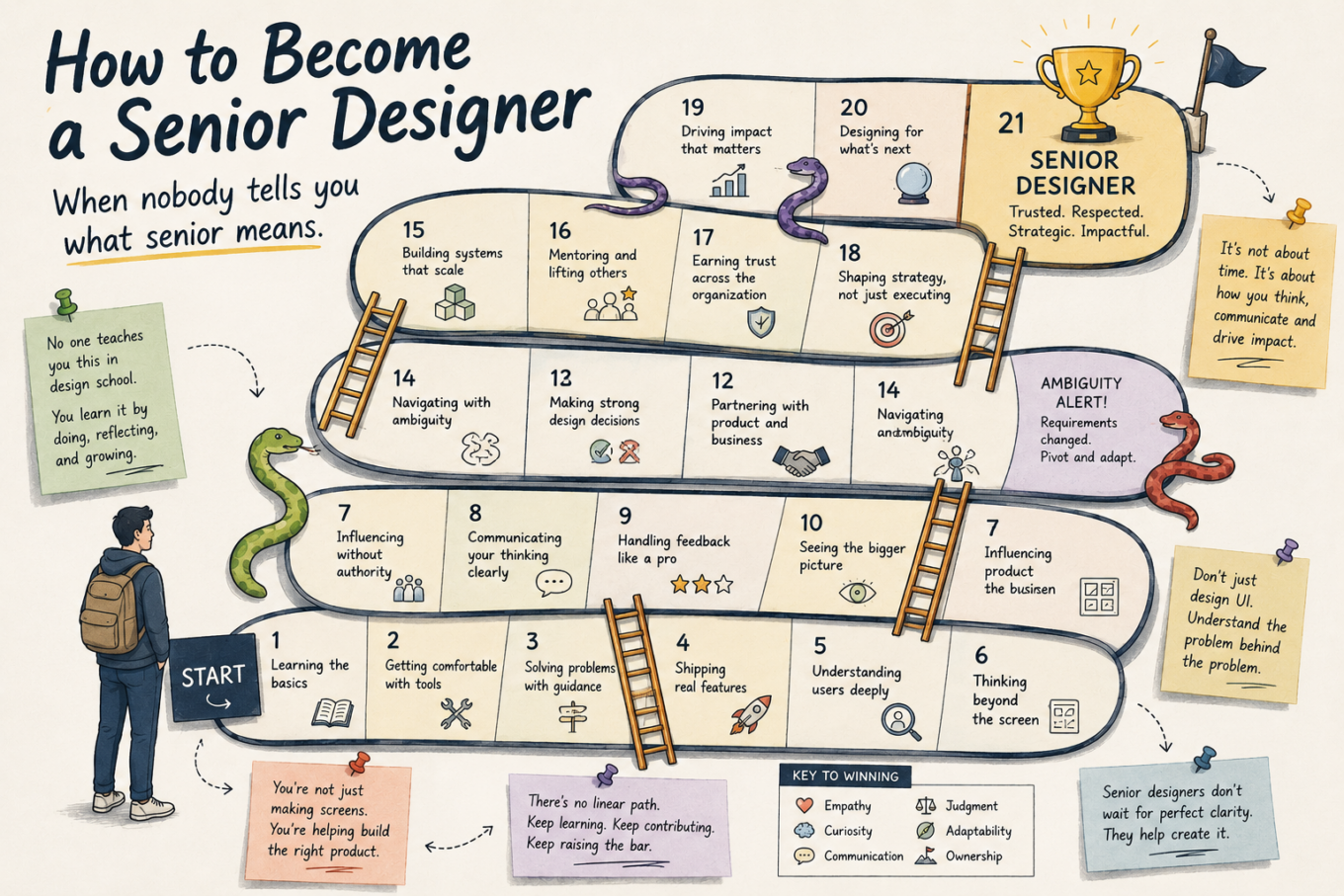
There is a phase in many product designers’ careers where the next step feels incredibly close. You are no longer the junior designer learning the fundamentals. You have spent years designing products, shipping features, working with engineers, sitting through sprint ceremonies, navigating stakeholder feedback, and learning how products are built inside organizations.
Naturally, the next question becomes whether you are ready for a senior role.
I have seen many designers reach this exact point in their careers and honestly, I think this transition is one of the most misunderstood stages in product design. Because one of the biggest myths in our industry is the idea that seniority is directly tied to years of experience. That if someone has been designing for five to seven years, becoming a senior product designer should happen automatically.
On paper, it sounds logical. Most careers train us to think this way. More years equals more experience. More experience equals more seniority. But product design does not always work like that.
Over the years, I have met designers with fewer years of experience who operated with remarkable seniority. I have also met designers who had been in the industry for much longer yet still approached their work from an execution-first mindset. The difference was rarely talent, and it was almost never visual craft alone.
I remember there was also a phase in my own career where I became deeply interested in understanding what actually separates intermediate designers from senior ones. Not just the title itself, but the shift underneath it. The shift in mindset, communication, ownership, and perspective that companies are really looking for when they hire senior product designers.
Looking back, I don’t think the answer was more experience. I think the answer was a different set of skills altogether.
Tip #1: Learn how to talk about design, not just execute it
A big shift that happens when moving into senior product design roles has surprisingly little to do with Figma itself. It is communication.
Junior and intermediate roles are often heavily execution-focused. You are evaluated on whether you can take requirements, design flows, improve usability, create polished interfaces, and deliver work efficiently.
But senior roles operate differently. At senior levels, your work enters rooms where people ask much harder questions.
Not: “Can you design this screen?”
But:
“Why does this interaction exist?”
“What user behavior are we trying to influence?”
“What business problem does this solve?”
“Why should this action appear here instead of somewhere else?”
“What tradeoff are we making with this decision?”
And this is where many designers feel stuck when trying to move into senior roles. Because the conversation is no longer just about visual execution. It becomes about reasoning.
Stakeholders will rarely remember whether your UI looked aesthetically polished. But they will absolutely care whether your decisions make sense for users, business goals, technical constraints, and long-term product direction.
Tip #2: Expand your design vocabulary outside of work
This is one reason I believe reading is one of the most underrated skills in product design.
Not because every designer needs to spend their evenings reading design books. And not because reading automatically makes someone a better designer. But because reading expands the way you think about problems.
Throughout my career, I have noticed that experienced design leaders often have a different way of framing discussions. They reference ideas from psychology, product strategy, behavioral design, systems thinking, business, or even completely unrelated fields. Their perspectives feel broader because they are drawing from a larger collection of mental models.
There is a reason design leaders are constantly asked what books they are reading, what podcasts they listen to, or what thinkers have influenced them. The question is never really about the book. It is about understanding how they think.
Two designers can have exactly the same number of years of experience and operate at completely different levels. One may have spent those years primarily executing requirements. A senior product designer may have spent those same years continuously expanding their perspective through reading, learning, observing, and questioning how products work.
Tip #3: Stop behaving like a pair of hands in the room
This was probably one of the most important lessons I learned during my time at eBay. Walk into the room with a point of view.
Not an opinion manufactured for the sake of sounding smart. Not a contrarian take designed to create debate. A genuine perspective rooted in your understanding of the problem.
Many designers spend years becoming exceptionally good at executing requirements. They receive a problem, solve it thoughtfully, and move on to the next thing. Organizations need people who can do this well. But senior designers are expected to contribute something more.
They are expected to influence the discussion itself.
- Do you agree with the problem definition?
- Are there assumptions nobody is questioning?
- Is there another direction worth exploring?
- Are we optimizing for the right outcome?
These are not questions that emerge from execution. They emerge from judgment.
One thing I learned very quickly was that having a point of view that later changes after feedback is completely acceptable. In fact, it is often a sign of a healthy design process.
What is much harder to work with is someone who arrives with no perspective at all.
The strongest designers I have worked with were not always the loudest people in the room. They were often the people who had thought deeply enough about the problem to contribute a meaningful perspective, while remaining flexible enough to change their minds when new information appeared.
Tip #4: Senior presentations are not performances. They are strategic meetings
Before joining eBay, I already considered myself a strong presenter. I was comfortable speaking in front of groups. My decks were clean, my narratives were structured, and I rehearsed thoroughly before important presentations.
Then I started presenting to senior leaders. And I realized these were not presentations at all. They were strategic conversations disguised as presentations.
Imagine your team finally secures thirty minutes on a leader’s calendar. A meeting people have been waiting weeks to get. You know the leader will have questions. You know they will challenge assumptions. You know feedback is the entire reason the meeting exists.
Which means your thirty-minute meeting is not actually thirty minutes. Realistically, you may have fifteen. The rest belongs to discussion. That changes how you prepare.
You stop thinking about how to present confidently and start thinking about how to use the room effectively.
- What decision do you need from this meeting?
- What exactly needs feedback?
- What can be skipped?
- What questions are likely to come up?
- Where should you defend your position and where should you simply listen?
I learned that the best presentations were rarely the most polished ones. They were the ones that helped unblock a team, create alignment, clarify a decision, or move a project forward.
Tip #5: A senior product designer is comfortable with ambiguity
The biggest differences I have noticed between intermediate and senior designers is how they react when the plan changes.
Most designers early in their careers understandably prefer clarity. The requirements are defined, stakeholders are aligned, success criteria are known, and the designer’s job is to execute well against them.
But a Senior product designer process is rarely that neat.
As you move into more senior roles, you quickly realize that requirements change. Research uncovers unexpected findings. Leadership reviews challenge assumptions. Stakeholders disagree. Priorities shift. Entire directions get reconsidered after months of hardwork.
What surprised me over time was that the strongest senior designers rarely view these moments as failures or design churn. They view them as part of the process.
This was one of the biggest lessons I learned as I moved into more senior and design lead roles. Increasingly, my responsibility was not just to design solutions, but to help teams navigate uncertainty, manage changing inputs, and make sure we were solving the right problem before investing more time in solving it well.
Interestingly, you can often see this distinction reflected in senior product designer interviews.
The questions become less about how you executed against requirements and more about what happened when those requirements changed.
- Tell me about a project that didn’t go as planned.
- Tell me about a time you disagreed with stakeholders.
- Tell me about a project where research completely changed the direction of the work.
They are not testing whether you can operate when everything is clear. They are testing how you think when it isn’t. And perhaps that is the biggest shift of all. Because seniority is not demonstrated when the path forward is obvious. It is demonstrated when the path forward is uncertain.